 Pre-order
There's an admin guide. A developer guide. An architect guide.
Nobody wrote the designer's guide.
Until now.
What's Inside
The Paradigm Shift
- The single most important thing that happened to Salesforce design — and why most designers still haven't caught up
- Agents are users of your design — and they need to be designed for
- Designing for two audiences simultaneously: the human and the AI agent behind it
- What "agentic" actually means in plain language (no, it's not just a chatbot with a fancy name)
The AI Product Landscape
- Agentforce, Einstein, Atlas, Data 360, Prompt Builder, Trust Layer — what each one is and which ones you actually touch
- The simplified architectural diagram a designer can actually internalize
- What designers influence directly vs. indirectly — and why the distinction matters
- Why "just turn on Einstein" is the most dangerous sentence a stakeholder can say
Trust & Transparency Patterns
- The Trust Spectrum: from "fully transparent" to "invisible automation" — and the framework for deciding where every feature lands
- Confidence indicators: what visual cues for AI certainty look like, when they help, and when they become noise
- Graceful degradation: what the user experiences when the AI gets it wrong
- Progressive disclosure of AI reasoning: layered transparency for different users
Anatomy of an Agent
- The four building blocks of every Agentforce agent — and why each one is a design decision
- Topics, Instructions, Actions, Guardrails — the design decisions hidden inside admin config
- Three architectural patterns: Greeter, Operator, Orchestrator
- The exact map of which agent decisions the designer should own vs. delegate
Designing the Conversation
- Conversations are not screens — you're designing a flow, not a layout
- The agent has a personality whether you design one or not — so design one
- Conversation flow maps: the deliverable that replaces user flows for agent experiences
- The shift from designing screens to designing behaviors
Prompt Builder as a Design Tool
- Why prompt templates are UX artifacts — and why designers should be writing them
- The evolution of microcopy: you're writing instructions for the AI that generates the label
- What a prompt template design spec actually looks like — goal, constraints, tone, format, guardrails
- The prompt-test-refine cycle as a design activity (not a developer activity)
Context Engineering
- Why AI doesn't understand your business — it understands the data you give it
- Ontologies: structured maps of how business concepts relate — and what happens when they're messy
- Why data quality is not an IT problem — it's a user experience problem
- Designers as advocates for user-facing terminology in the semantic layer
Channels, Handoffs & Voice
- The same agent, five different channels: how design adapts across surfaces
- The warm handoff: carrying conversation context so humans don't start from scratch
- Making escalation feel like progress instead of failure
- Voice agent design: brand personality expressed through tone, pacing, and vocabulary
Table of Contents
Part I: The Shift
Chapter 1: The Agentic Platform
- From System of Record to Agentic EcosystemSalesforce's evolution in a single arc — and why "agentic" means the interface is no longer the only actor.
- The Product Landscape: Designer's Cheat SheetAgentforce, Einstein, Atlas, Data 360, Prompt Builder, Trust Layer — what each one is and which ones you actually touch.
- AI Agents as a New Kind of UserYou're now designing for two audiences simultaneously: the human in front of the screen and the AI agent behind it.
Part II: Designing for Trust
Chapter 2: What Designers Need to Know (That Nobody's Telling Them)
- The Gap Between Trailhead and Design PracticeTrailhead teaches configuration. Architect docs assume technical depth you don't have. Here's what actually fills the space.
- The Four Critical Design Skills for the AI EraExperience architecture, agent collaboration design, conversation design, and context mapping — introduced here, unpacked across the book.
- Stable Ground vs. Shifting SandWhat's solid enough to build a practice around — and what's moving too fast to bet on.
Chapter 3: The Einstein Trust Layer — Through a Design Lens
- What the Trust Layer Is (Designer's Version)Not a feature you design — a set of constraints you design within.
- Data Masking: What Your Users Actually SeePII gets replaced before it reaches the LLM. What that means for previews, confirmations, and generated content.
- Zero Data Retention: The Transparency ParadoxThe AI forgets everything immediately. Designing for an AI that doesn't remember — and the user expectations that creates.
- Toxicity Filtering: When the AI Says NoWhat happens on screen when a response gets blocked — and how to design a state that isn't an error or a dead end.
- Grounding: Data Quality Is a UX ProblemAI responses are only as good as the data underneath them. Here's your advocacy role.
- Audit Trails as a UX SurfaceEvery AI interaction is logged. For some industries, that log needs to be visible. Designing for it without overwhelming the primary experience.
Chapter 4: Trust and Transparency Patterns
- The Trust SpectrumFrom "fully transparent" to "invisible automation" — and the framework for deciding where any given AI feature belongs.
- Trust Signal PatternsSource attribution, confidence indicators, "AI Generated" labels, and provenance trails — when each one helps and when it becomes noise.
- Human-in-the-Loop DesignThe review fatigue problem: users rubber-stamping AI outputs because reviewing is harder than doing.
- Designing for AI FailureThe AI will get things wrong. The question is what the user experiences when it does.
- Progressive Disclosure of AI ReasoningMost users don't want to see the chain of thought. Some do. Layered transparency for both.
Part III: Conversational Experience Design
Chapter 5: Anatomy of an Agent Experience
- The Four Building BlocksTopics, Instructions, Actions, Guardrails — and why each one is a design decision, not an admin task.
- The Three Architectural PatternsGreeter, Operator, Orchestrator — when each is the right call and what it means for how you design the conversation.
- What the Designer InfluencesA clear map of which agent configuration decisions you should own, collaborate on, and hand off.
Chapter 6: Designing the Conversation
- Conversational UX Principles for AgentsConversations are not screens. You're designing a flow, not a layout.
- Intent and AmbiguityDesigning for misunderstood intent, clarification patterns, and the cost of asking too many questions.
- Conversation Flow MappingThe design deliverable that replaces user flows — happy paths, clarification paths, and failure paths.
- Persona, Tone, and Brand VoiceThe agent has a personality whether you design one or not. So design one.
- Agent vs. Chatbot: Why the Design Approach Is DifferentChatbots follow decision trees. Agents reason and plan. The shift from screens to behaviors.
Chapter 7: Channels, Handoffs, and Voice
- Multi-Channel Agent DesignThe same agent across chat, Experience Cloud, Slack, email, and voice — what stays consistent and what adapts.
- Channel-Specific ConsiderationsChat widget, portal, Slack, email — each surface has different constraints, pacing, and social dynamics.
- Escalation and Handoff DesignMaking escalation feel like progress, not failure. Warm handoffs, cold handoff anti-patterns, and context preservation.
- The Designer's Role in Omni-ChannelWhat you influence in routing logic, queue design, and the AI-to-human transition.
- Voice Agent DesignBrand personality without pixels. Tone, pacing, vocabulary — and the uncanny valley you need to design around.
Part IV: Prompt Design and Context
Chapter 8: Prompt Builder as a Design Tool
- Prompt Templates Are UX ArtifactsYou're no longer writing the label. You're writing the instructions for the AI that writes the label.
- Template Types and When Each AppliesSales Email, Field Generation, Record Summary, Flex — and how to identify which one fits.
- The Prompt Template WorkspaceWhere prompts are built, tested, and refined — and why the resolution view is the step most teams skip.
- What the Designer SpecifiesGoal, constraints, tone, format, guardrails — and what a prompt template design spec actually looks like.
Chapter 9: Context Engineering for Designers
- What Context Engineering IsAI doesn't understand your business. It understands the data you give it.
- Ontologies and Metadata MapsStructured maps of how business concepts relate — and what happens to the agent when they're messy.
- The Semantic Layer in Data 360When different teams call the same metric different names, the AI experience breaks.
- Data Quality: The Upstream UX ProblemYou can't fix the data. But you can design for it — and make the case to stakeholders that it's their problem too.
Part V: AI Across the Clouds
Chapter 10: Designing AI Experiences in Sales, Service, and Experience Cloud
- Common Patterns Across CloudsThe patterns that apply everywhere — and where each cloud starts to diverge.
- Sales: Agentforce SalesAI-generated outreach, lead scoring visualization, opportunity summarization, and pipeline insights.
- Service: Agentforce ServiceThe highest-impact AI use case on the platform. Customer-facing agents, case summarization, and the review moment that makes or breaks adoption.
- Experience Cloud: AI Meets External UsersPortal design with embedded agents, permission-aware surfaces, and Einstein Bot vs. Agentforce agent.
- The Cross-Cloud Design ChallengeUsers don't think in clouds — they think in tasks. Designing AI experiences that feel unified across three products.
Part VI: The Practice
Chapter 11: The AI Design Engagement Model
- How AI Changes DiscoveryNew questions: cost of AI error, data quality, regulatory constraints, and who reviews outputs before users see them.
- New Stakeholder ConversationsEducating leadership that "just turn on Einstein" is not a strategy — framing AI as a design problem.
- New DeliverablesPrompt specs, agent persona definitions, escalation flow maps, trust pattern documentation, AI touchpoint maps.
- Data Quality AdvocacyThe designer's new responsibility for the layer below the UI — and how to make the case that bad data is a UX problem.
Chapter 12: Accessibility, Measurement, and What's Next
- Accessibility in AI InterfacesAI interfaces fail accessibility basics more than any other type. Screen readers, keyboard navigation, cognitive load, and neurodiversity.
- Measuring AI UX SuccessOverride rate, escalation frequency, trust score, time-to-resolution — the metrics that actually tell you if the AI is helping.
- What's ComingMulti-agent orchestration, A2A protocols, MCP interoperability, multimodal AI, and when the agent IS the interface.
- The Career Path ForwardConversational design, context engineering, and experience architecture as the skills that compound.
Stay informed.
Be the first to know when Salesforce AI Design launches. Get release updates, early access, and a preview chapter before anyone else.
The lessons that took years to learn. Yours in a weekend.
Every chapter comes from real Salesforce AI implementations — the mistakes, the breakthroughs, and the design decisions that AI can't teach you because nobody's written them down. Until now.
All packages are digital downloads (PDF + ZIP). No physical products are shipped.
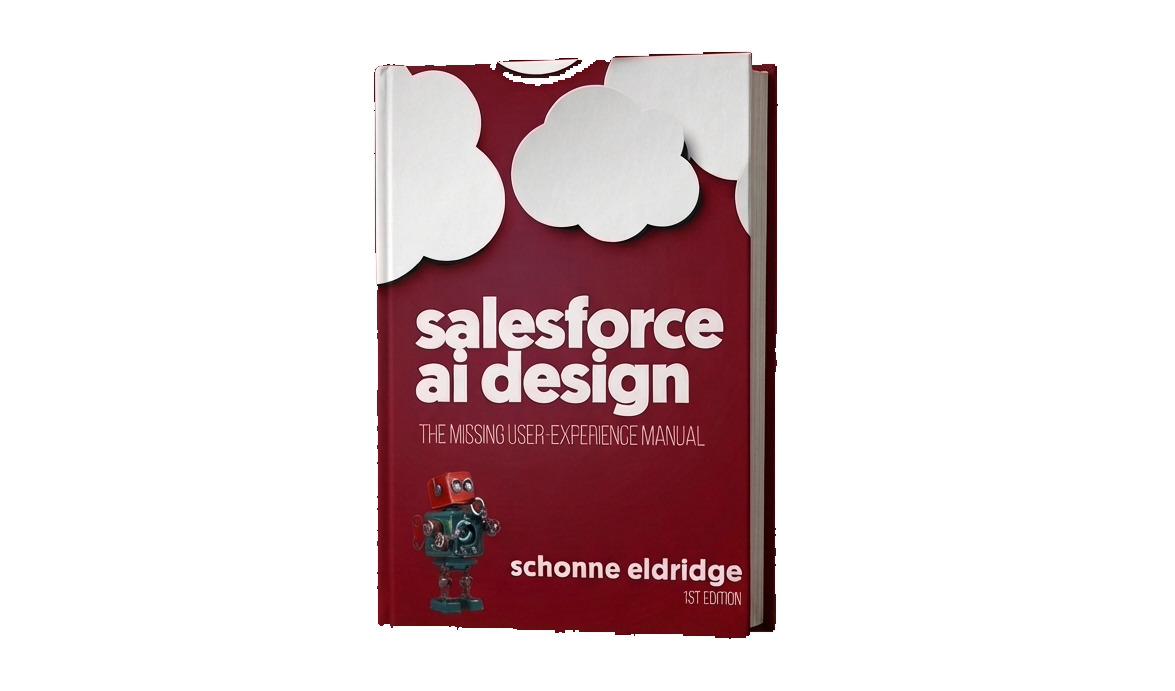
book
$49
- Full PDF book (12 chapters)
- Instant download on release
most popular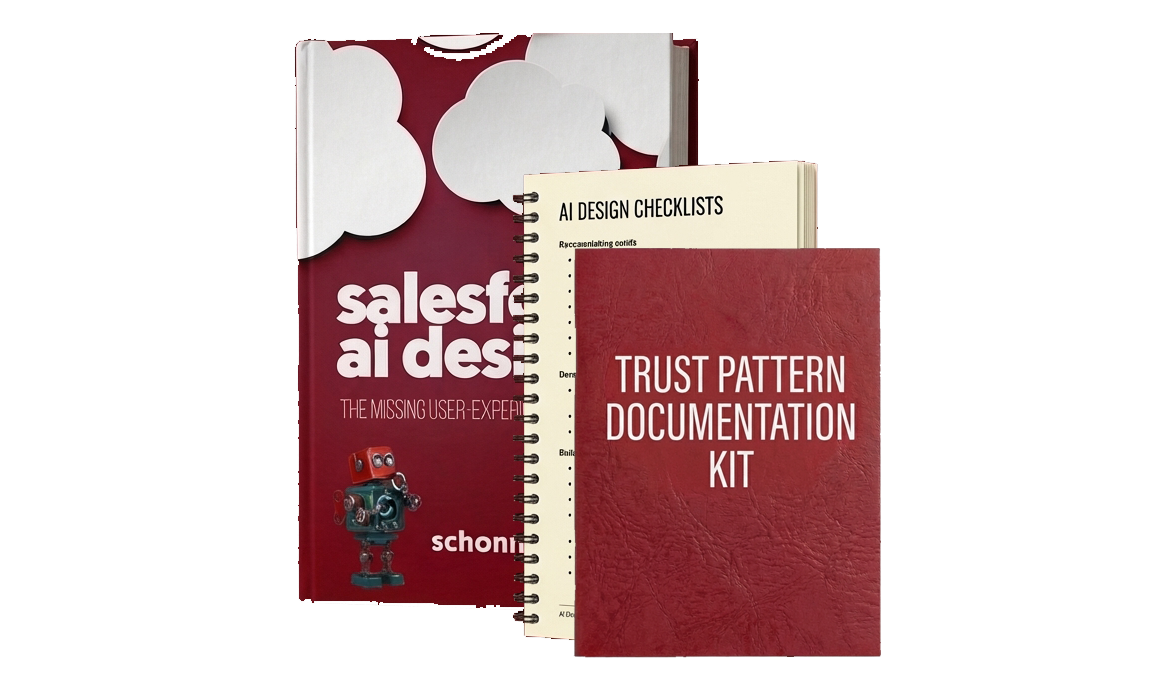
complete
$99
- Full PDF book (12 chapters)
- Lifetime free updates
- AI design checklists7
- Agentforce Readiness Checklist
- Einstein Feature Evaluation Checklist
- Salesforce AI Prompt Quality Checklist
- AI-Generated Flow Review Checklist
- Trust Layer Compliance Checklist
- AI Feature UX Audit Checklist
- Data Cloud AI Readiness Checklist
- AI design templates7
- Agentforce Agent Specification Document
- Einstein Copilot Action Design Template
- Prompt Template Design Document
- AI Feature Requirements Document
- Human-AI Workflow Map (Salesforce)
- AI Pilot Program Template
- Stakeholder AI Capability Briefing
- Trust pattern documentation kit6
- Einstein Trust Layer Implementation Guide
- AI Disclosure Pattern Library
- User Control Patterns for Salesforce AI
- AI Error Communication Guide
- Feedback Loop Documentation
- AI Governance Framework Template
masterclass
$149
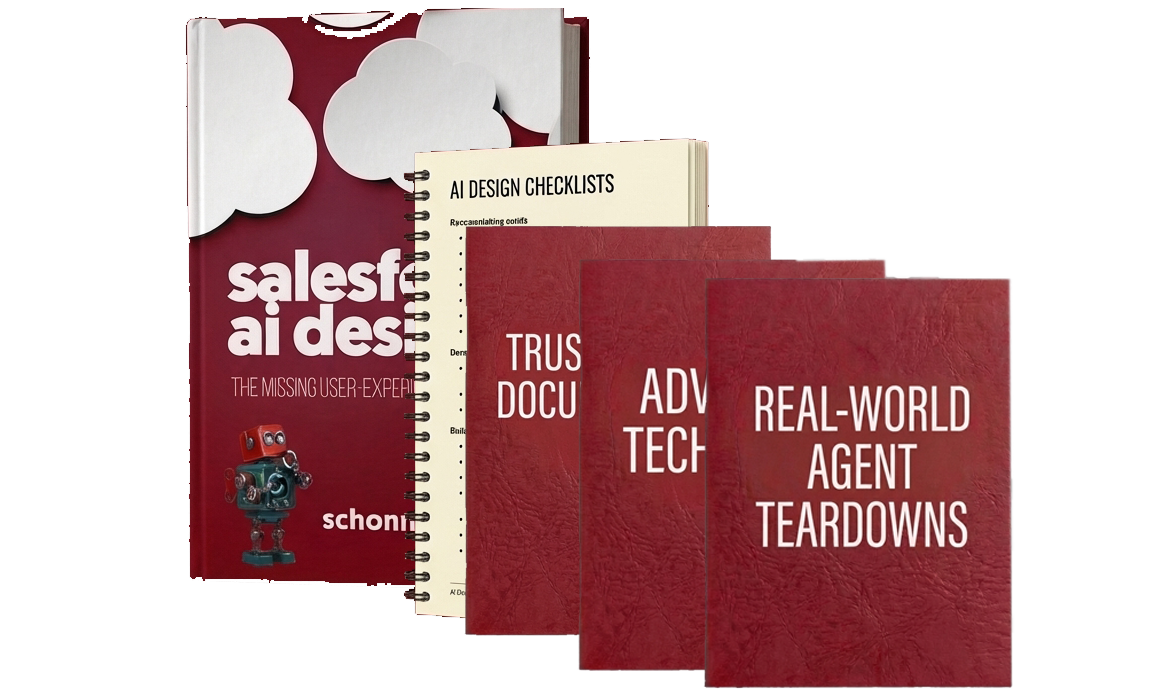
- Full PDF book (12 chapters)
- Lifetime free updates
- AI design checklists7
- Agentforce Readiness Checklist
- Einstein Feature Evaluation Checklist
- Salesforce AI Prompt Quality Checklist
- AI-Generated Flow Review Checklist
- Trust Layer Compliance Checklist
- AI Feature UX Audit Checklist
- Data Cloud AI Readiness Checklist
- AI design templates7
- Agentforce Agent Specification Document
- Einstein Copilot Action Design Template
- Prompt Template Design Document
- AI Feature Requirements Document
- Human-AI Workflow Map (Salesforce)
- AI Pilot Program Template
- Stakeholder AI Capability Briefing
- Trust pattern documentation kit6
- Einstein Trust Layer Implementation Guide
- AI Disclosure Pattern Library
- User Control Patterns for Salesforce AI
- AI Error Communication Guide
- Feedback Loop Documentation
- AI Governance Framework Template
- Advanced techniques8
- Multi-Agent Orchestration Patterns
- Einstein + Flow Integration Patterns
- Data Cloud + AI Feature Design
- Agentforce Custom Action Development
- Cross-Cloud AI Experience Design
- AI-Powered Experience Cloud Patterns
- Performance Optimization for AI Features
- Einstein Analytics + AI Integration
- Real-world agent teardowns6
- Service Cloud Agentforce Implementation Teardown
- Sales Cloud Einstein Copilot Teardown
- Experience Cloud AI Bot Teardown
- Einstein Next Best Action Teardown
- Field Service + AI Teardown
- Marketing Cloud + Einstein Teardown